Showing posts with label astronomy. Show all posts

Thursday, December 23, 2010

Star-gazing


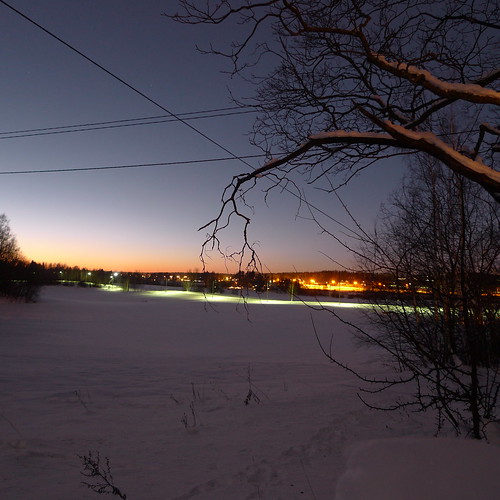
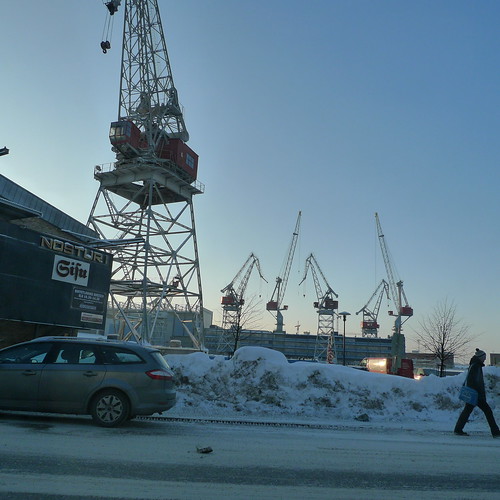
Lifting, originally uploaded by jiihaa.

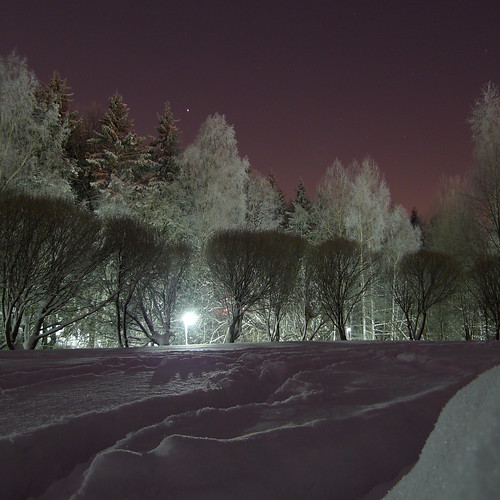
Up, originally uploaded by jiihaa.

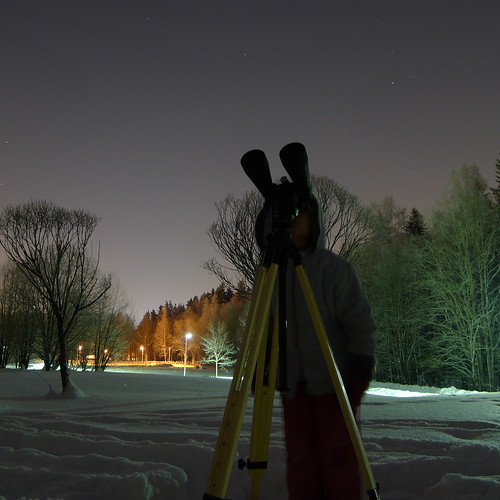
Jupiter, originally uploaded by jiihaa.

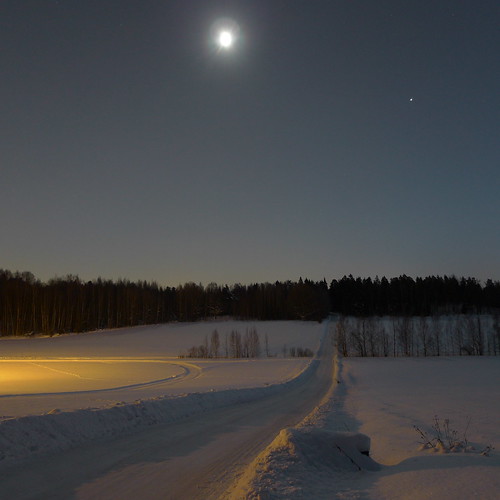
Sky, originally uploaded by jiihaa.

Well, I went ahead and bought the tripod I mentioned earlier, Berlebach 3042. It isn't lightweight (and definitely not cheap), weighting 4.5 kg with the Manfrotto video head, but it works just as a tripod for star-gazing should. Stable, easy to set up, and relatively easy to adapt to shorter and taller people (such as children and adults). I got mine from the Ursa astronomical association (info in Finnish here), where I got some expert instruction as well.

After moonrise we went out with the children to have a look at the sky. It was -24 °C outside, so we couldn't stay out long. Despite the light pollution and some thin clouds we managed to catch a good look at the Moon, and at Jupiter as well. I think I saw one of the Jupiter moons as well, but maybe I was mistaken. And a wooden tripod really is good when it is so cold, awful to think about operating something made of metal, makes one shudder.

Wednesday, December 15, 2010

A good tripod for star-gazing binoculars?


Moon and Jupiter, originally uploaded by jiihaa.

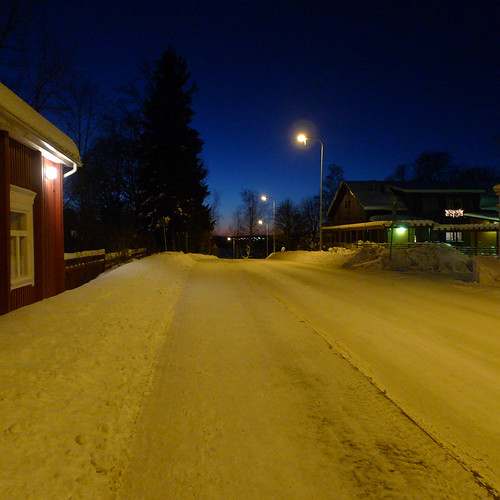
Road, originally uploaded by jiihaa.

Skyline, originally uploaded by jiihaa.

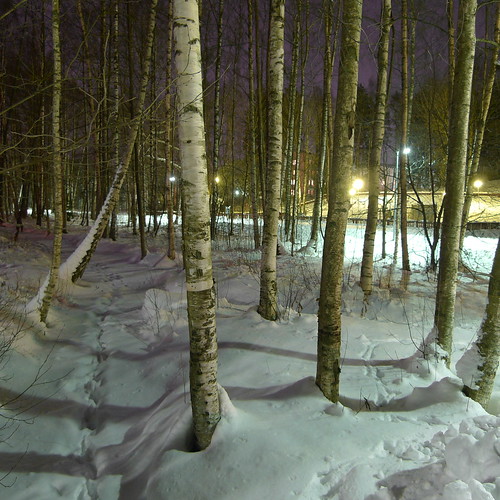
Winter, originally uploaded by jiihaa.

A few days ago I got a new toy, Celestron 15x70 SkyMaster Binoculars, which are especially designed for astronomical watching, a.k.a. star-gazing. It is said that these binoculars offer "incredible value for money", and I think this is not far off the mark.

Problem is, I don't have a tripod to use with the binoculars. The binoculars weight 1.36 kg, and you really need a support for viewing the sky.

One suggestion is a tripod made of ash wood, namely Berlebach 3042, but I'm not yet convinced this is the one to use. It does have good properties, such as ability to view without too much stooping, and the center column in a rotating base seems to be a workable design. And a wooden tripod is nice to handle when the temperature is below freezing.

However, I would like to get a second opinion on this. I might use the tripod for photography as well, although I'm not too keen on lugging one around on long walks. The Berlebach weights 3.5 kg, and 4.5 kg with a good video head (Manfrotto 128RC).

Saturday, August 14, 2010

Next, something completely different: a big-sensor camera


Poisonberry, originally uploaded by jiihaa.

Dry, originally uploaded by jiihaa.

What would you think of a camera which has a 6.7 meter aperture and a 3.2 gigapixel sensor? Handy to have, hmmm...

The specifications of the LSST (Large Synoptic Survey Telescope) are fascinating. In fact, the LSST Science Book is a fascinating read in other parts also, not only the camera specs. But it is a hefty download at over 50 megabytes.

Here are some quotes from the book. First, on Optics and Telescope Design:

The Large Synoptic Survey Telescope (LSST) will have an effective aperture of 6.7 meters and an imaging camera with field of view of 9.6 square degrees, and will be devoted to a ten-year imaging survey over 20,000 square degrees south of +15 deg. Each pointing will be imaged 2000 times with fifteen second exposures [...]

[...] the standard visit time in a given field is only 34 seconds, quite short for most telescopes. The time required to reorient the telescope must also be short to keep the fraction of time spent in motion below 20% [...] The motion time for a nominal 3.5◦ elevation move and a 7◦ azimuth move is five seconds. In two seconds, a shaped control profile will move the telescope, which will then settle down to less than 0.1′′ pointing error in three seconds.

The mount uses 400 horsepower in the azimuth drive system and 50 horsepower in the elevation system. There are four motors per axis configured in two sets of opposing pairs to eliminate hysteresis in the system. Direct drive systems were judged overly complicated and too excessive, so the LSST design has each motor working through a multi-stage gear reduction, with power applied through helical gear sets. The 300-ton azimuth assembly and 151-ton elevation assembly are supported on hydrostatic bearings.

Next, a few words about the camera:

The LSST camera [...] contains a 3.2-gigapixel focal plane array [...] comprised of 189 4 K × 4 K CCD sensors with 10 μm pixels. The focal plane is 0.64 m in diameter, and covers 9.6 deg2 field-of-view [...] The CCD sensors are deep depletion, back-illuminated devices with a highly segmented architecture, 16 channels each, that enable the entire array to be read out in two seconds [...]

A total of 189 4 K × 4 K sensors are required to cover the 3200 cm2 focal plane. To maintain high throughput, the sensors are mounted in four-side buttable packages and are positioned in close proximity to one another with gaps of less than a few hundred μm. The resulting “fill factor,” i.e., the fraction of the focal plane covered by pixels, is 93%.