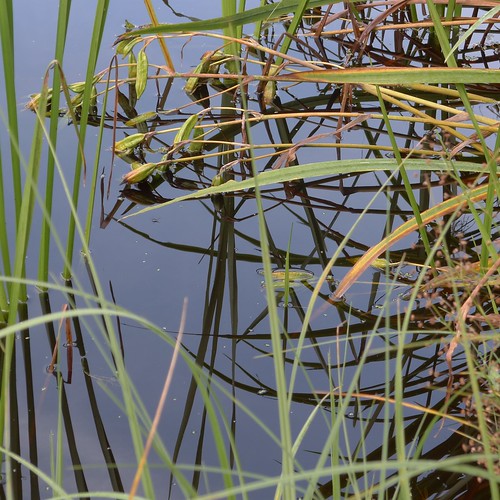
After getting some experience in shooting RAW with the LX5, I have come to the conclusion that there are only some situations when it is really worth the extra effort: high-ISO situations, and when one wants to preserve highlight information.
But the drawbacks are the slower shooting speed - waiting for the camera to respond doesn't feel so good - and the extra effort in Aperture. Even though I have some presets which help in RAW processing, it takes work in front of the computer to get good enough results. (And I prefer spending time behind the lens instead.)
I'll use RAW mainly for handheld photography when it is dark, and not much else. Previously, I put the LX3 on a mini-tripod and used ISO 100, and that worked quite well, but limited the possible compositions quite drastically. Now that I'm using Aperture I'll have more freedom during the dark season. That is good.
On the other hand, in many situations the JPEG engine of the LX5 does an excellent job. One such situation is shooting b&w. The LX5 has an excellent film mode for this, "dynamic b&W".
I think it would be very hard to get the same results from the RAW files - and I doubt this can be easily automated. There was a discussion about this at Flickr, but nobody knew of a solution.
Thursday, September 1, 2011
When to use RAW on the LX5
Thursday, July 21, 2011
How the Panasonic LX3 looks after 200,000 photographs taken with it
Arthur asked: "Please, can we have a picture of the camera!"
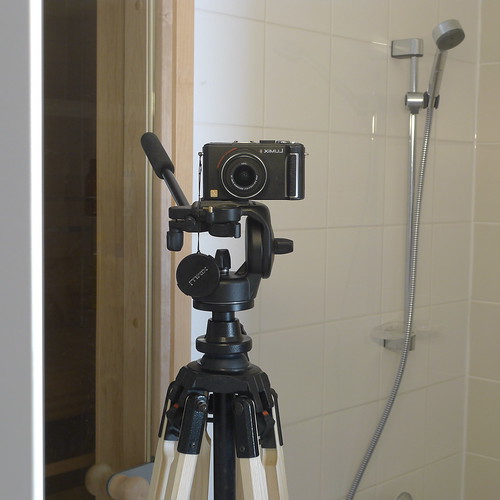
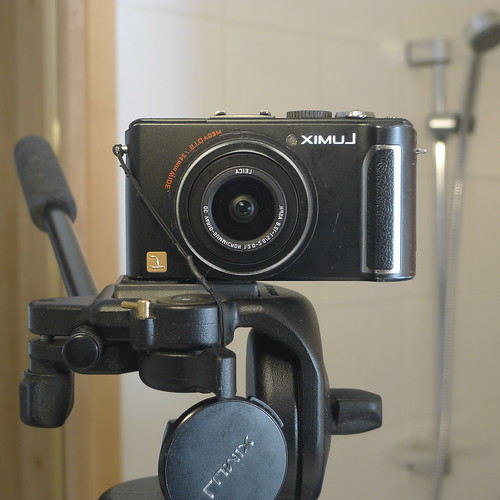
So, here you are, self-portraits of the LX3 after 200,000 photographs taken with it. I mounted the LX3 on top of my Berlebach tripod, which I use with astronomical binoculars. A bit of mismatch in sizes there with the camera and the tripod...
As I'm taking the LX3 everywhere I go, why not the shower as well?
On a more serious note, when I had my first digital camera, the Canon Ixus 400, I was very cautious about taking photographs in the rain. With the LX3 I have relaxed a lot - rain doesn't bother it much. Just wipe most of the water away after you get inside, and let it dry.
The LX3 has gotten a lot of punishment in other ways also. I have dropped it on rock, on ice, on snow, and on a hard floor. After I first dropped it (on a rock), I was convinced that it was broken - but nothing happened. And nowadays I try to be cautious, but don't stress it too much if the camera is dropped.
The Ixus 400 did break down after being dropped on the floor - the built-in lens cover stuck and didn't work. That may be one reason for the better durability of the LX3, not having such a thing.
If you look carefully at the LX3 self-portrait, you can see some signs of wear around the lens, on the ring where the lens cover is attached: it was originally all black.
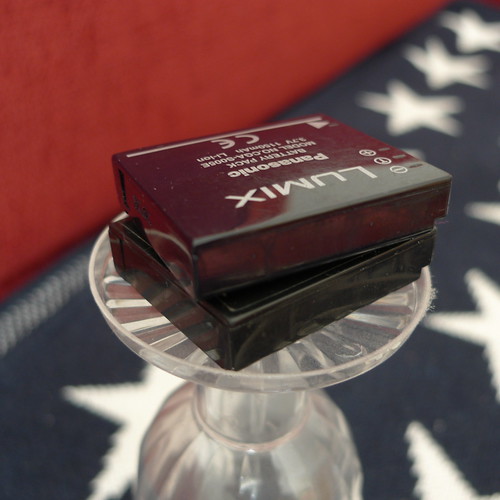
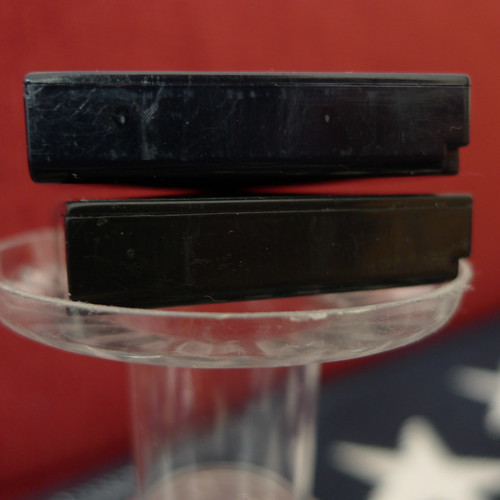
I included here also photograph of the batteries which started bulging and didn't fit into the battery compartment any more. Now I have two new batteries, each lasting up to 800 photographs on one charge. It is good...
I couldn't take closeups of the camera bottom, where the biggest signs of wear are, as the LX3 is currently my only camera able to focus close. (With the Nokia E7 the closest focusing distance is 50 cm.) It would be of course interesting to lovingly document all the little scratches, bending plates and worn materials - but I'll leave that for now.
Sunday, January 2, 2011
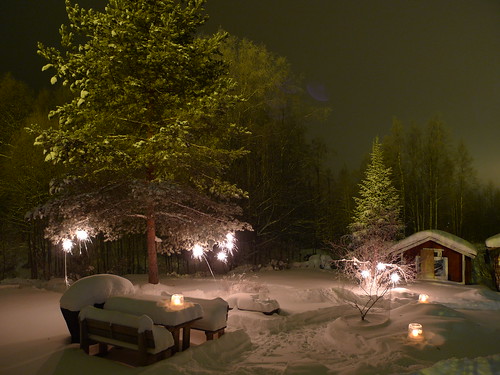
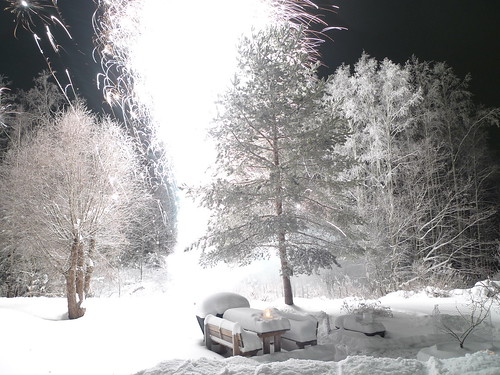
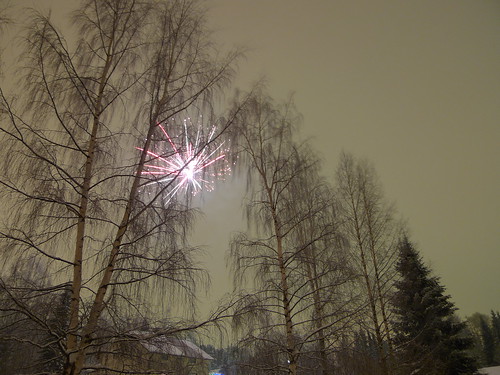
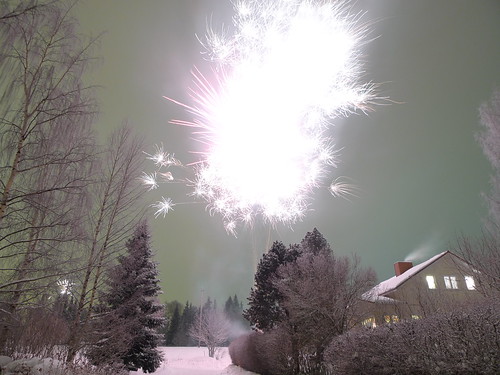
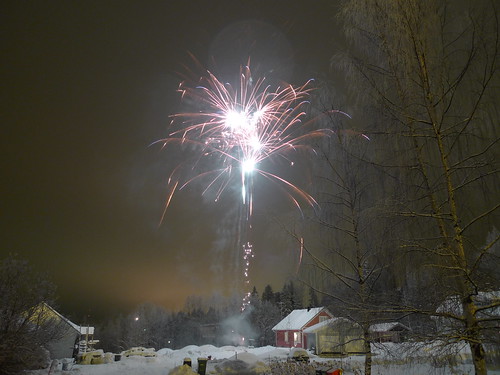
Fireworks - putting a 0.3 kg camera on a 4.5 kg tripod
Before this year, it was difficult to take photographs of fireworks, as I didn't have a proper tripod for the camera, only a small mini-tripod. Now that I have to Berlebach 3042, which I bought for the star-gazing binoculars, I have a really stable tripod to use for photography.
Putting a 0.3 kg camera on a 4.5 kg tripod may be a bit overkill, or at least the LX3 looked really tiny on top of the massive tripod. But I managed to take quite a few photographs of fireworks, so this combo works quite well. And I didn't even bother with using a self-timer, as I realized there wasn't hardly any tremble when I pressed the shutter on the LX3.
Not all photographs succeeded properly, because I was using automatic exposure instead of manual, but even some of the overexposed photographs were sort of interesting to see.
Happy New Year 2011!